
The word art is recent. The practice it describes is ancient, and was, for most of human history, indistinguishable from ritual, religion, healing, and the work of community.
A Diné medicine person creating a sand painting in the late nineteenth century was not making art in the contemporary sense. A West African mask carver shaping a ceremonial face for a specific dance was not producing decoration. A Tibetan monk laying colored grains into a mandala over the course of weeks was not building gallery work. They were doing something the modern English vocabulary has no precise word for — something the contemporary West has been trying to recover ever since it lost it.
The question this piece takes up is not whether art can be a vehicle for self-discovery. The question is how the modern world forgot that it ever was anything else, and what it means to remember. This piece belongs to the visual stream of creative practice, and it is the older root underneath the contemporary clinical work.
The Ancient Lineage
A short, geographically diverse tour of expressive practice as it has actually existed across human cultures.
The cave paintings of Lascaux and Chauvet
The earliest dated cave art at Chauvet, in southern France, is roughly thirty-six thousand years old. Lascaux is younger, around seventeen thousand. Both galleries appear in caves that were almost certainly not used as dwellings — they were dedicated sites, reached by long passages, lit by torchlight. Current archaeological consensus suggests ritual context: hunting magic, initiation rites, shamanic practice. Whatever the specific function, the makers were not painting for an audience in the modern sense. They were doing something with materials and image that the body and the imagination required.
Shamanic art across cultures
In Siberia, the Amazon, the Arctic, and across Indigenous traditions worldwide, the mask, the drum, the painted body have functioned as instruments of altered state and integration. The shaman’s regalia is not costume in the theatrical sense — it is technology for entering and returning from territories of the psyche the ordinary mind cannot reach.
Diné sand painting
In Diné (Navajo) healing ceremonies, intricate ground paintings made of natural pigments are created over many hours, used in the ceremony itself, and then destroyed afterward. The making is the medicine. The painting is not preserved because its purpose was never to be a finished object — its purpose was the ritual it enabled.
West African mask traditions
Across the Yoruba, Dogon, Bambara, and many other cultures of West Africa, ceremonial mask-making has been a specialized ritual practice for centuries. The mask is consecrated, used in specific ceremonies, and carries spiritual weight that the wood and pigment alone cannot account for. The carver is not an artist in the modern sense; the carver is a ritual specialist.
Eastern contemplative arts
Tibetan Buddhist sand mandalas are constructed over weeks of meticulous work and then ritually dispersed. Japanese sumi-e ink painting and Chinese brush calligraphy are practiced as forms of moving meditation, the brush stroke understood as the visible record of the practitioner’s inner state in that moment. In each case, the practice is the point; the object is the byproduct.
Every continent’s pre-modern traditions used expressive practice for self-discovery, healing, and meaning-making. The contemporary West is the historical anomaly, not the default.
The Modern Discovery: How Expressive Therapy Emerged
In the twentieth century, the West began to rediscover what it had set aside.
The formal discipline of art therapy emerged in the 1940s and 1950s through the work of two pioneering practitioners. Margaret Naumburg, often called the founder of American art therapy, drew on psychoanalytic theory to develop a practice in which images created in session became material for therapeutic dialogue. Edith Kramer, working in parallel, emphasized the inherent therapeutic value of the making itself — what she called “art as therapy” rather than “art in therapy.” Both frameworks remain influential in the contemporary discipline.
Carl Jung’s contribution to the rediscovery is older and runs deeper. Jung’s practice of active imagination — engaging with the unconscious through image, dialogue, and structured visual journaling — predates the formalization of art therapy and shaped it substantially. Jung kept his own visual journal, The Red Book, for nearly two decades; published only in 2009, it stands as one of the more remarkable documents of one psyche meeting itself through image.
The expressive arts therapy movement of the 1970s, led by figures including Shaun McNiff, integrated multiple modalities — visual art, movement, music, drama, writing — into a single therapeutic framework. The argument was that confining therapeutic expression to a single medium misunderstands how the psyche actually communicates with itself.
What the modern West has constructed under names like art therapy and expressive therapy is, in important ways, a clinical re-creation of what older traditions practiced as everyday ritual. The frame is different. The mechanism is the same. The recognition that image, made by hand, can reach what speech cannot is one of the oldest insights humans have, and one of the most reliably effective.
What Self-Discovery Through Art Actually Looks Like
The practical answer cuts against the popular framing.
Self-discovery through art is not about producing recognizable images or pleasing compositions. It is not about technical skill, aesthetic refinement, or anything you would learn in a drawing class. It is about externalizing the internal — putting onto a page or into a material what cannot be put into words.
The image, drawing, or object reveals something the verbal mind would not have surfaced alone. A color choice repeats across three pages and the maker notices, slowly, what the color means to them. A figure appears in the corner of a journal entry over and over and gradually clarifies into a recognizable inner voice. A shape that emerged from intuitive scribbling resolves, weeks later, into the form of a feeling that had been waiting for a way to be seen.
The practitioner then witnesses what surfaced, lives with it, and lets it speak. The image is not the destination. The image is the artifact of a process the maker did with themselves, and the witnessing of that artifact afterward is part of the practice.
What you make is rarely shown to anyone. What you make is rarely framed, photographed, or shared. What you make is, in most cases, looked at by you and you alone, and then placed back in the drawer or the notebook or the studio corner. The process — not the product — is where the discovery happens.
Three Practices That Work Without Talent
Three practical entry points for the reader who has decided they cannot draw.
Visual journaling. Keep a notebook in which writing and image live in the same space, with no separation between modes. A morning page of writing. A sketch in the margin. A color washed across the back of a sentence. A torn scrap of paper glued onto the corner of a thought. The mixing is the practice — the verbal mind and the image mind in the same room, learning to talk to each other. (A short meditation practice settles the nervous system into the state visual journaling does its best work from — the two practices pair naturally.)
Intuitive drawing. Fifteen minutes, no plan, no judgment. The question is not what looks good. The question is what wants to come through. Hold a pen or a pencil over the page and let the hand begin moving. Where it wants to go is information. What it wants to draw is information. The work is to follow rather than direct. Most people report being startled by what surfaces in the first three sessions.
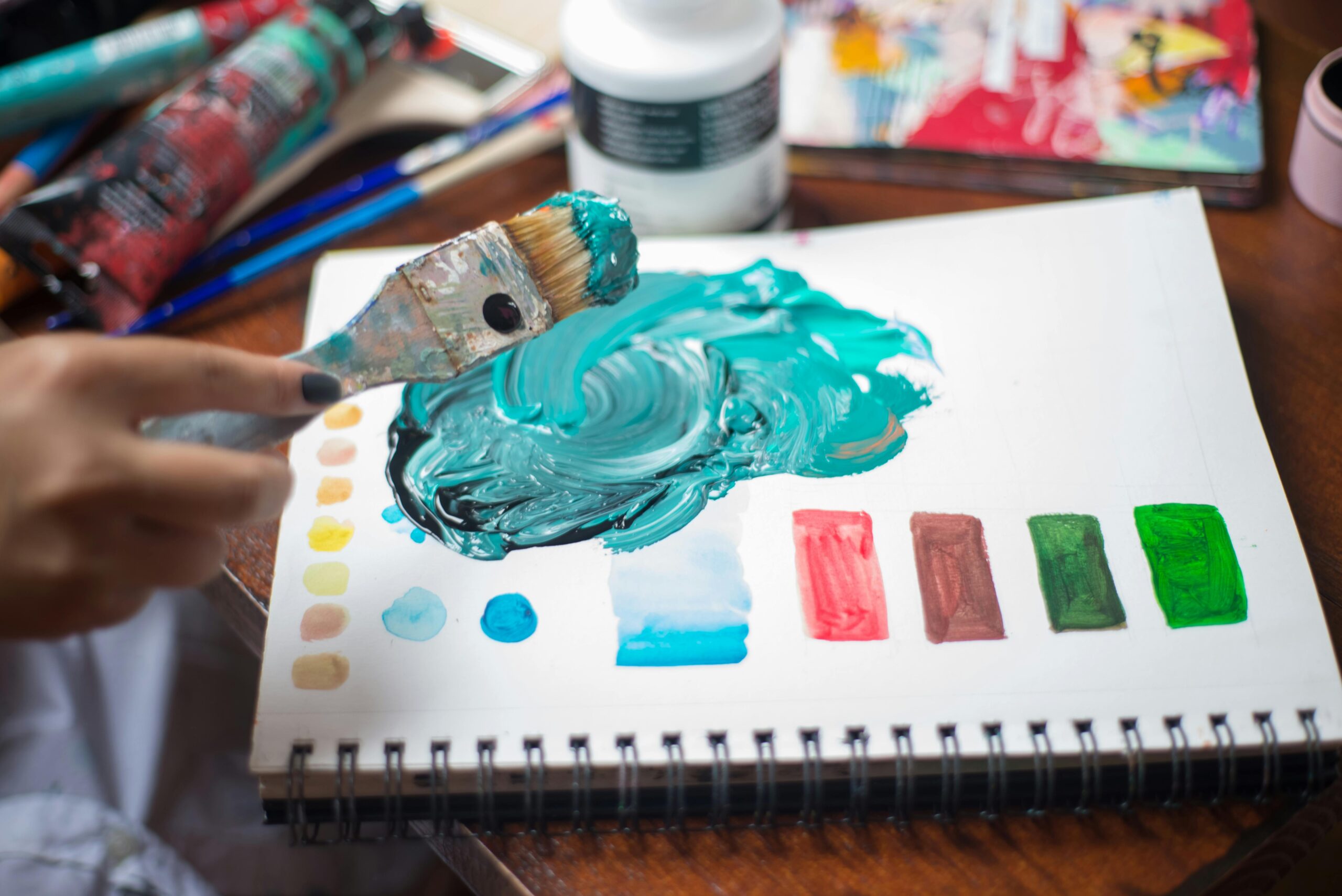
Collage and assemblage. Work with found materials, photographs, magazine scraps, found objects. The curation itself is the creative act — choosing what speaks, arranging what was chosen, placing it on a surface in relationship to itself. No drawing skill required. The image is built by selection rather than by mark. This is one of the most accessible entry points for anyone who has decided they are “not artistic.”
Closing
The contemporary reader who picks up a brush, a pen, or a stack of magazines for a collage is joining a practice that is fifty thousand years old. Not as art in the gallery sense. As the older thing the word art used to mean — ritual, attention, the working-out of something the verbal mind cannot say.
The work is not new. The practice was waiting. Begin with the medium that calls you, in the form that is small enough to do tomorrow. The lineage will hold the rest.
Frequently Asked Questions
Art is the broader category — making with intent for any purpose. Art therapy is a specific clinical practice, conducted by a credentialed art therapist with masters-level training, that uses art-making within a therapeutic relationship for psychological support. The two overlap but are not synonymous. Self-led creative practice for self-discovery can be deeply valuable without crossing into the clinical territory of formal art therapy.
No. This is the most common reason people opt out, and it is wrong. The practice is about process, not product. Technical skill is not required. Intuitive drawing, visual journaling, and collage are all accessible entry points that depend on attention rather than ability. What you make is rarely shown to anyone; the making is what matters.
Traditional talk therapy works primarily through language. Expressive therapy works through making — visual art, movement, music, drama, writing, or some combination. The premise is that some psychological material cannot be reached through language alone and requires other modalities. Expressive therapy is often used alongside talk therapy rather than as a replacement.
Most practitioners notice shifts within two to four weeks of consistent practice — fifteen minutes a session, three times a week. Deeper insights and integration tend to emerge across months. The practice rewards consistency over intensity, and the work compounds in the way reflective practice does — slowly, durably, across years.
Yes. Self-led practice with simple materials (a notebook, pencils, watercolors, magazines for collage) is a meaningful entry point for most readers. For clinical concerns — trauma, persistent depression, eating-related distress — working with a credentialed art therapist is the appropriate path, not self-led practice alone.