
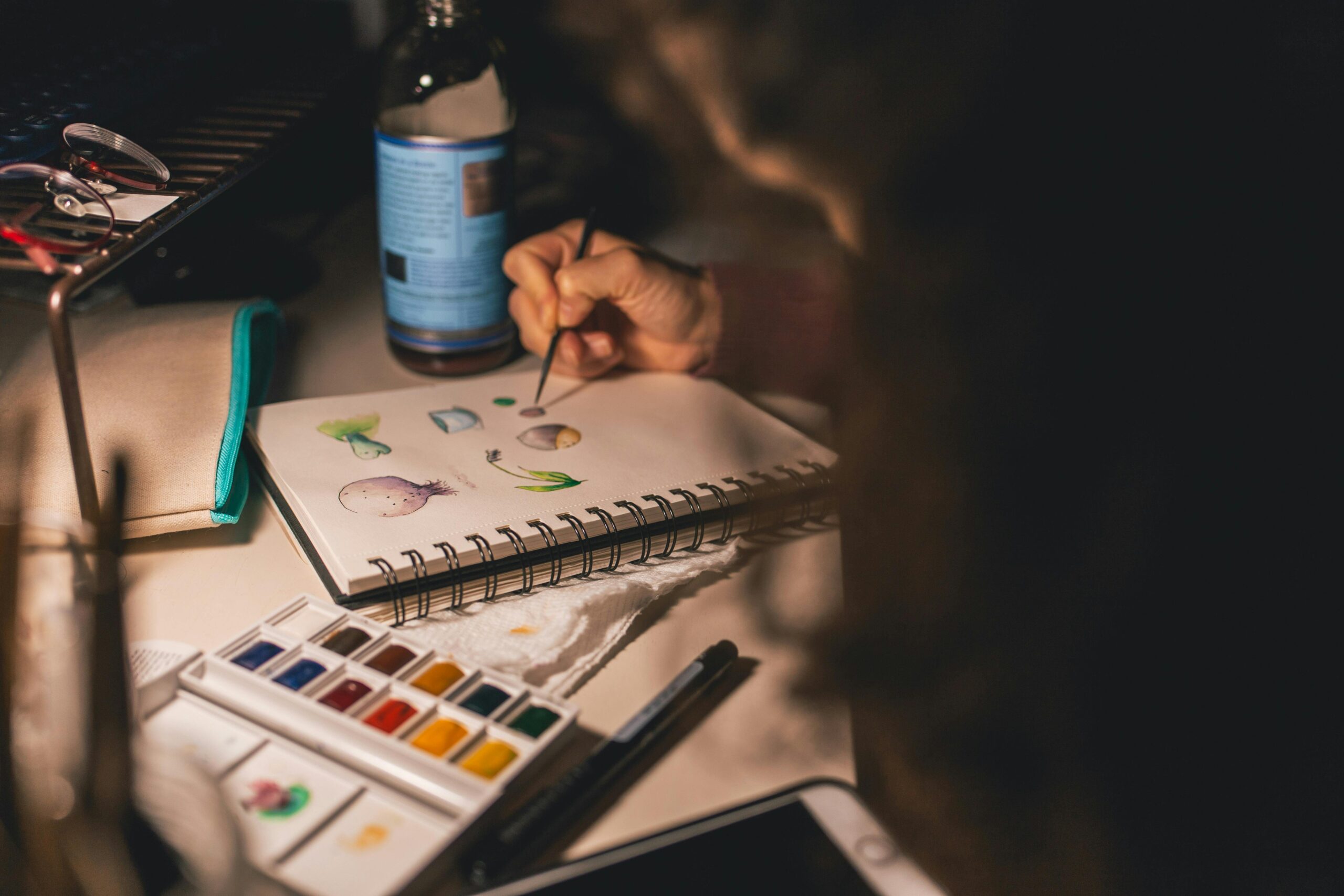
There is a single belief that has cost more people more creative practice than any other.
It is the belief that creativity is a fixed trait. You are either artistic or you are not. You either inherited it or you did not. You either showed talent at seven years old, or you opted out at eight, and the decision is settled.
This is wrong. It is widely held, deeply absorbed, and entirely wrong. The contemporary research on creativity treats it as a practice, not a trait — a skill that responds directly to engagement, available to anyone willing to spend the time. The people who become creative across decades are not the ones who were chosen at seven. They are the ones who kept practicing.
This piece is about why that matters for wellness, and how to begin a creative practice even if you have decided you are not the kind of person who does this.
What Creative Practice Actually Means
Creative practice is the disciplined act of bringing something into form that did not exist before. The medium can be visual — drawing, painting, photography, ceramics, textiles. It can be material — cooking, gardening, sewing, building, repairing. It can be narrative — writing, storytelling, performance, songwriting. The form does not matter. The practice does.
This is the move that opens creative practice to readers who have correctly observed that they cannot draw, paint, or play an instrument, and concluded incorrectly that creative practice is therefore unavailable to them. The drawing is one possible form. The thousand other forms remain open. A meal cooked from scratch is creative practice. A garden cultivated across seasons is creative practice. A story told well to a child at bedtime is creative practice. A sentence written privately in a journal that no one else will ever read is creative practice. None of these will hang in a gallery. All of them count.
The Wellthxology framing: creative practice belongs to the same family of disciplines as meditation, reflection, and contemplative attention. It is a mode of being, not a market category. The output is a byproduct of the practice; the practice itself is the point. This is the reframe that makes everything that follows possible. Without it, the rest of this piece is unreachable. With it, the rest of this piece is an invitation back into something that was always available.
Why the Body and Brain Need It
The science underneath the case.
Flow state
The psychologist Mihaly Csikszentmihalyi spent decades researching what he eventually called flow — the state of complete absorption in a challenging-but-doable activity, where time, self-consciousness, and effort all dissolve. Creative practice is one of the most reliable producers of flow available to ordinary life. The state is itself measurably restorative — lower cortisol, better mood, a kind of psychological refreshment that few other activities deliver as consistently.
Default mode network
The same brain circuit involved in reflection and integration during contemplative practice also lights up during making. Creative engagement appears to activate the integrative circuits that consolidate experience into meaning, the same way structured reflection does. This is why a single afternoon of making often produces insights that a week of trying-to-think-it-through did not.
Expression as nervous-system regulation
Making with the hands and body engages the parasympathetic nervous system. The slow, repetitive motions of painting, kneading, sewing, or stirring lower physiological stress markers measurably. The act of expression itself — putting an internal state into external form — completes a circuit the body otherwise leaves open.
The maker’s loop
Producing something — even something small, even something private — produces a dopamine signature distinct from the dopamine of consuming something. The maker’s loop is structurally healthier than the consumer’s loop. It is sustained by what you do, not by what is served to you, and it does not require ever-larger inputs to keep producing the same effect.
These are not soft benefits. They are mechanisms documented across decades of research. The body and brain were built for making, and the absence of making is one of the more under-recognized contributors to contemporary unwellness.
The Three Streams of Creative Practice
Creative practice is broader than the contemporary “art class” framing of it. It runs in three main streams, and most people are called to one more than the others.
The visual stream. Making with image and form. Drawing, painting, sculpture, photography, ceramics, printmaking — the practices the modern world most readily recognizes as “art.” This is the stream Wellthxology’s piece on art as a form of self-discovery takes up at the level of ancient and modern history, and the piece on art therapy takes up at the level of contemporary clinical practice. For the reader drawn to image-making, those two posts are the deeper reading.
The narrative and storytelling stream. Making with words and structure. Writing, journaling, storytelling, songwriting, performance, the construction of meaning through narrative. This stream is older than the visual one in some ways — humans were telling stories around fires long before they were painting on cave walls, and the oral traditions of every culture preserved the practice across thousands of years. The Wellthxology cluster takes this up across three pieces: the lost art of storytelling on ancient cultures, the spirituality of storytelling on myth and meaning, and transforming pain into power on narrative as a vehicle for healing. For the reader drawn to words, those three posts are the deeper reading.
The everyday and embodied stream. The making that lives inside daily life — cooking, baking, gardening, sewing and fiber arts, hair, makeup, music-making, spoken word, dance, personal style, hospitality, building and repairing. This is the stream the modern wellness conversation most reliably leaves out, because the practices live under labels (cooking, hair, fashion, music) that the conversation has stopped recognizing as creative. The Wellthxology piece on the creative practices we don’t recognize as creative takes this up at length. For the reader whose creative life is already happening in the everyday but has not been allowed to count, that post is the deeper reading.
The three streams are not mutually exclusive. Many practitioners work across them — the visual journal that combines drawing and writing, the songwriter who paints, the chef who tells stories at the table, the gardener who photographs the garden. Most readers will find one stream calls them more strongly than the others. That call is information. Pay attention to it. The medium that draws you is the one to begin with.
— A note from the editor —
The Wellthy Chronicles is the weekly companion on Substack for readers building creative practice into a life — slow notes from someone doing the same work. Free and paid tiers, both worthwhile.
Common Misconceptions
Five misreadings worth naming directly.
It’s about talent. Wrong. Creative practice is about doing, not about being good. The person who has practiced for ten years is more creative than the person who is naturally gifted but has not practiced. Talent without practice is potential energy. Practice without talent is creative practice. The second one is what produces a creative life.
It’s about output. Wrong. The output is a byproduct, not the goal. The practice is what produces the wellness benefits, the integration, the meaning. The output is what gets left over afterward. Many of the most consistent practitioners produce work no one else will ever see.
It has to monetize. Wrong, and the pressure to turn creative practice into a business is one of the most reliable ways to kill it. The moment a practice becomes a product, the relationship to the practice changes. Some people can do both; many cannot. There is no shame in keeping the practice private and earning a living some other way.
It has to be impressive. Wrong. The practice is private until it isn’t, and most of it remains private forever. The poem in the bedside drawer is not lesser than the published one. The painting that lives on a closet wall is doing the same work as the one in a gallery.
You missed your window. Wrong. Creative practice has no entry age and no expiration date. The reader at sixty-five who begins is doing the same work, with the same benefits, as the reader at sixteen.
How to Begin Creative Practice
A starter framework rather than a starter product list.
Step 1 — Choose a medium that calls you, not one you think you should choose. The pull is information. The reader who has always been drawn to fabric should begin with fabric. The reader who has always wanted to write should write. Resist the inherited idea that the right medium is the prestigious one or the marketable one. The right medium is the one you keep returning to in your imagination.
Step 2 — Define the minimum viable session. Fifteen minutes, three times a week. This is the floor. Not the aspiration. The version that survives a hard week, a sick child, a deadline, a difficult month. The full version, on good days, can be longer. The floor is what keeps the practice alive in between.
Step 3 — Protect the practice from outcomes. No social media for the first thirty days. No “portfolio.” No showing the work to friends for feedback. No judgments of the work as good or bad. The practice has to be allowed to exist before it is allowed to be evaluated. Evaluation that comes too early routinely kills the practice it was meant to improve.
Step 4 — Find a way to make it social just enough. One person who sees what you make and does not critique it. Not an audience. Not a teacher in the early stage. A witness. The practice often needs the small dose of accountability that comes from someone else knowing it exists.
Step 5 — Watch for the limiting beliefs the practice will surface. They will surface. I am not the kind of person who does this. This is silly. I am too old, too inexperienced, too whatever. These are the sentences the work of dismantling limiting beliefs from the Mastery pillar is about. Name them. Examine them. Make the work anyway.
Creative Practice as a Lifelong Discipline
Creative practice is not a hobby. It is one of the longest-running technologies humans have for processing experience, building meaning, and tending the inner life. The discipline compounds across decades.
The reader who begins this month, in fifteen-minute sessions three times a week, will be a different reader in a year. Not because the work will be better — though it may be. Because the relationship between the reader and their own attention, their own inner life, their own capacity to bring something into form will have changed. The change is durable. It outlasts the moment, outlasts the practice session, outlasts the medium.
Begin small. The pen on the page. The hands in the clay. The first paragraph of the story that has been waiting. The lineage holds the rest.
Continue the pillar:
— The Visual Arts branch —
→ Art as a Form of Self-Discovery: Ancient and Modern Perspectives on Expressive Therapy
→ How Art Therapy Can Help You Unlock Your Creativity and Heal
— The Storytelling branch —
→ The Lost Art of Storytelling: How Ancient Cultures Used Narratives for Well-Being
→ The Spirituality of Storytelling: How Myths and Fables Teach Us Life Lessons
→ Transforming Pain Into Power: The Art of Storytelling for Healing
— The Everyday & Embodied branch —
→ The Creative Practices We Don’t Recognize as Creative
Frequently Asked Questions
Creative practice is any disciplined act of bringing something into form that did not exist before. Visual practices (drawing, painting, photography, ceramics), material practices (cooking, gardening, sewing, building), and narrative practices (writing, storytelling, songwriting) all qualify. The medium varies; the underlying gesture is the same. What matters is the practice, not the medium or the output.
No. Creative practice is a skill that responds to engagement, not a trait you inherit. The contemporary research on creativity treats it as practice-dependent rather than fixed. The reader who practices consistently for a year is more creative than the naturally gifted reader who has not practiced. Engagement is the variable; talent is incidental.
Fifteen minutes per session, three times per week, is enough to produce measurable benefits across weeks and months. The depth opens through consistency rather than through intensity — a forty-five-minute weekly total maintained for six months produces more than a four-hour weekend produced once.
No. Creative practice is a self-led discipline available to anyone, with no clinical infrastructure required. Art therapy is a credentialed clinical profession that uses art-making within a therapeutic relationship to support psychological well-being. Both can be valuable; they are different categories. For clinical concerns, working with a credentialed art therapist is the appropriate path.
Yes — the research base is substantial. Creative practice activates flow state, engages the parasympathetic nervous system, and produces measurable reductions in stress markers. For mild to moderate symptoms, regular practice is one of the more effective interventions in the research literature. For clinical-level concerns, creative practice complements rather than replaces professional support.