



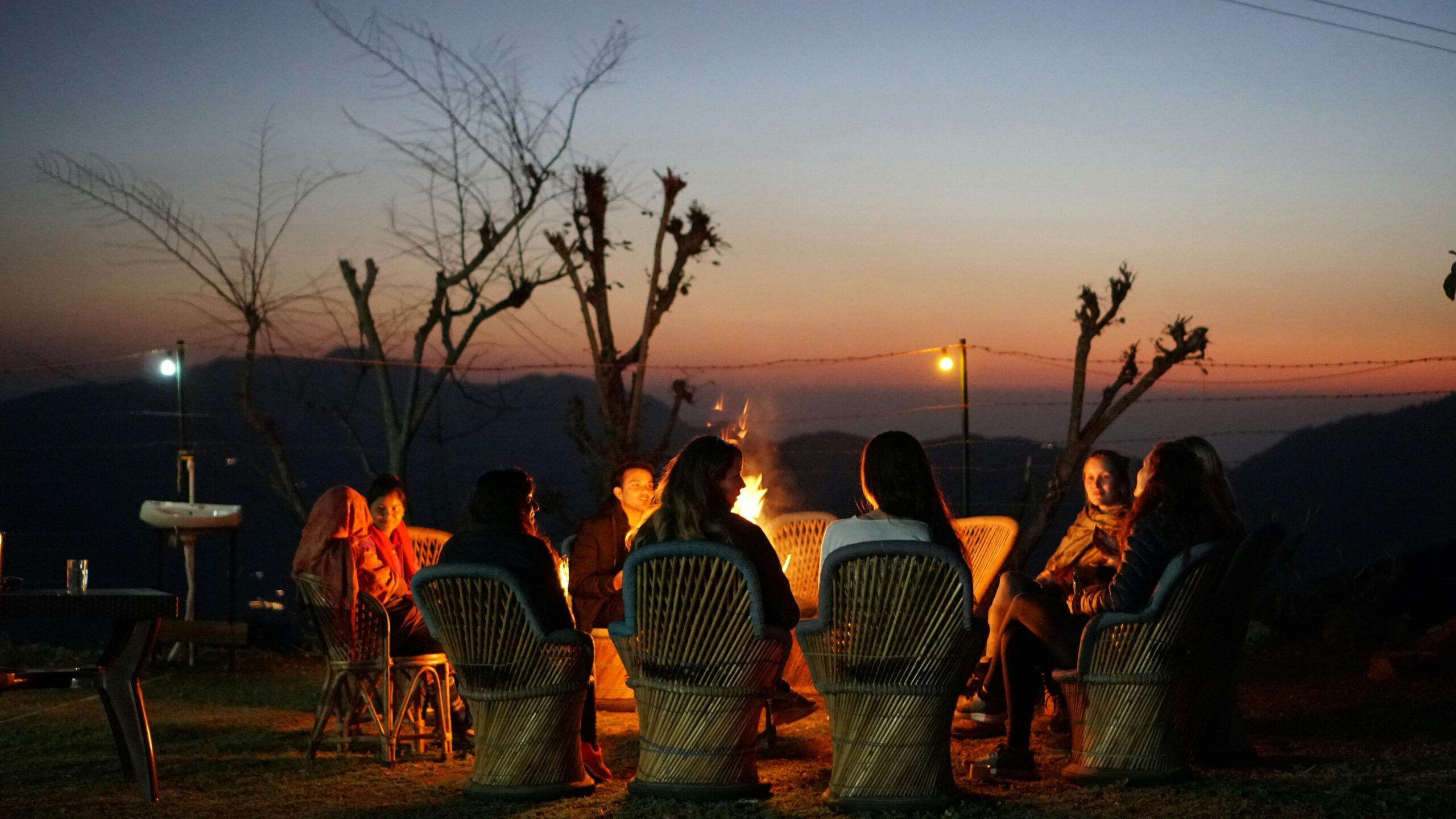
Before written language, before recorded music, before any form of mediated content, humans sat around fires and told each other stories.
This was not entertainment in the modern sense. It was the primary technology by which knowledge was preserved, identity was formed, healing was enacted, and culture was transmitted across generations. The storyteller was a specialist. The audience was a community. The story was the operating system of an entire civilization.
We have not stopped needing this. We have only stopped doing it. The displacement of slow, communal, oral narrative by fast, mediated, solitary content is one of the most significant cultural shifts of the last hundred years, and most of us have not yet reckoned with what was lost in it.
This piece is about that loss, and about what it might mean to begin recovering the practice — as readers, as listeners, as tellers. It belongs to the narrative stream of creative practice, and it is the longest-running version of that practice on the human record.
Storytelling as Human Technology
Story is not entertainment layered over information. Story is the substrate the human brain runs on.
The historian Yuval Noah Harari argues in Sapiens that the capacity for collective fiction — the ability to share stories large groups of strangers will believe and act on — is the evolutionary innovation that made large-scale human cooperation possible. Money is a story. Nationhood is a story. Religion is a story. Companies, laws, identities — all of them are agreements held together by shared narrative. Without story, there is no society larger than the immediate family band.
The neuroscience research points in the same direction. Recent neuroimaging studies have shown that the brain processes story differently from information. When listening to a structured narrative, both the speaker’s and the listener’s brains begin to synchronize — the same regions activate in the same sequence. Information transmission causes none of this; story does, reliably. The brain is structurally hungrier for narrative than for fact, which is why a parable, an anecdote, or a sermon will be remembered when a list of bullet points will not.
This is the evolutionary inheritance the modern reader has not stopped possessing. The appetite for story is not a luxury. It is the default setting of a system built over hundreds of thousands of years of human gatherings, where the survival of knowledge depended on whether someone could tell it well enough that someone else would tell it again. We are the descendants of those who could do this, and of those who needed to hear it. The equipment is still there. The cultural circumstances that called it forward have changed.
The Cultures That Knew
Every continent’s pre-modern traditions carried storytelling as central practice, with specialists, protocols, and forms developed across centuries. A brief, deliberately specific tour.
The West African griot
Across the Mande peoples of present-day Mali, Guinea, Senegal, Burkina Faso, and the broader Sahel, the griot is a hereditary class of musicians, historians, and storytellers — jeli in Mandé languages, often imperfectly translated into French as griot. The griot carried entire genealogies, the histories of ruling families, the moral teachings of the culture, the stories that made a person a member of a lineage. Trained over decades. Honored as essential to communal life. Still practicing today.
Aboriginal Australian Dreamtime narratives
Across many First Nations of Australia — Yolngu, Anangu, Pitjantjatjara, Wiradjuri, and others — Dreamtime stories integrate cosmology, geography, ancestry, and moral instruction in a way that has no direct Western equivalent. The stories map onto the landscape itself; specific stories belong to specific lands, and the right to tell them is governed by careful cultural protocols. These are sacred narratives, not entertainment, and the protocols around when and by whom they may be told are part of the practice.
The Irish and Scottish seanachaí
In Gaelic tradition, the seanachaí was the keeper of clan history, genealogy, mythology, and the moral instruction of Celtic culture. The position predates literacy and survived alongside writing for centuries because oral transmission carried something written transmission could not — the cadence, the voice, the moment of meeting between teller and listener.
North American Indigenous oral traditions
Across hundreds of distinct nations on North America — Diné, Lakota, Anishinaabe, Haudenosaunee, and many others — the tribal storyteller carried cosmology, ethics, ancestral memory, and the teachings each generation needed. The specific protocols around when stories may be told — some only in winter, some only by certain people, some only in certain contexts — are part of the tradition; treating these stories as freely circulated content is itself a misunderstanding of the practice.
The South Asian epics
The Mahabharata and Ramayana existed for centuries as performance traditions long before they were written texts. The reciter knew the entire work; the audience knew much of it too. Performance ran for nights at a time. The integration of moral instruction, mythology, history, and entertainment into a single form is a model of what story has always been able to do.
The Persian and Arabic narrative traditions
Ferdowsi’s Shahnameh, completed in the early eleventh century, gathered the mythology and history of greater Persia into a single epic poem of some fifty thousand couplets, designed to be heard. The Thousand and One Nights developed across centuries of oral telling before it took written form. The naqqāl — the Persian storyteller — held a recognized cultural role into the modern era.
The list is not exhaustive. Every continent carries others. The point is that the West’s recent flattening of “storytelling” into a marketing technique is a cultural amnesia about a practice the rest of the world has been refining for thousands of years.
— A note from the editor —
The Wellthy Chronicles is itself an attempt at slow, deliberate storytelling — weekly, on Substack. For readers building this practice back into a contemporary life, it is the companion.
What Modern Life Has Lost
Modern life has not lost the appetite for story. That appetite is what powers the streaming industry, the social feed, the autoplay queue. It is the same evolutionary hunger that filled the firesides for fifty thousand years; the hunger has not changed.
What modern life has lost is the form. The story we consume now is fast, mediated, solitary, and disposable. The story we lost was slow, embodied, communal, and load-bearing. The medieval seanachaí carrying the entire history of a clan. The Aboriginal elder explaining a hill by telling the story the hill is. The griot whose memory contained the genealogies that made a kingdom a kingdom. None of these has a direct contemporary equivalent.
The cost of the trade is not abstract. It is measurable in loneliness — story was once the connective tissue of intergenerational community, and that connective tissue has thinned. It is measurable in meaning — the moral and spiritual architecture that older storytelling traditions used to provide has been replaced by content optimized to provoke reaction rather than transmit value. It is measurable in attention — the slow narrative form requires a kind of sustained engagement the contemporary nervous system has been trained out of.
This is not nostalgia. The older form is not coming back as a mass cultural default; it is unlikely the family Sunday dinner will replace the autoplay queue at population scale. But the practice is available to anyone who chooses to recover it, one story at a time.
How to Begin Reclaiming It
Practical entry points for the reader who wants to bring some of the older practice back into ordinary life.
Listening practices. Choose slower narrative forms deliberately. The unabridged audiobook of a long novel rather than the summary. The personal essay podcast rather than the news clip. Oral history projects — StoryCorps, the Moth, regional folklore archives — that preserve the slower form for the contemporary listener.
Telling practices. Recover the practice of telling family stories aloud. The structured Sunday-dinner narrative — a single story, told slowly, with the older generation as primary source. The deliberate passing-down of one specific family story per year, recorded if possible. The phone call with a grandparent in which the question is not how are you but tell me again about the time when.
Reading aloud. To children, to partners, to oneself. The neuroscience is clear that reading aloud activates the brain differently than reading silently — slower, more embodied, more memorable. The practice is available at any age, in any combination.
Joining a tradition. Most major cities have local storytelling collectives, oral history workshops, or community circles. They are easy to find and surprisingly welcoming to newcomers. The reader who wants to take the practice seriously will benefit from being among others doing the same. (The personal version of this same recovery — using narrative to metabolize one’s own experience — is the subject of the next piece in this branch of the cluster.)
Closing
The practice was never lost permanently. It was only abandoned by enough of the culture to make it feel rare. The reader holds the same equipment that produced fifty thousand years of human story — the voice, the memory, the listening ear, the willingness to sit with another person and trade attention for narrative.
Begin with one. The story you choose to tell to someone you love, or the one you choose to listen to slowly, deliberately, with a phone left in another room — that is the beginning of a recovery.
Frequently Asked Questions
Storytelling activates the brain in ways isolated information cannot. Neuroscience research shows that listening to a structured narrative synchronizes the listener’s brain with the teller’s, supports memory consolidation, and engages the integrative circuits that help process experience. Storytelling also addresses loneliness by creating intergenerational and communal connection that information consumption does not.
Oral storytelling is the practice of transmitting knowledge, history, and culture through spoken narrative rather than written text. It predates writing by tens of thousands of years and remains a living practice in many cultures — West African griot lineages, Aboriginal Dreamtime narratives, and Celtic seanachaí traditions are three among many. The form is slow, embodied, communal, and load-bearing.
Across many traditions, stories were used to integrate trauma, mark life transitions, transmit moral teaching, and connect the individual to a larger collective meaning. Indigenous healing ceremonies often included narrative components. Sufi teaching used parable as therapeutic instruction. Shamanic traditions across cultures used story as part of soul-retrieval and reintegration work. The mechanism is the same one modern narrative therapy uses today.
Modern entertainment is fast, mediated, solitary, and optimized to provoke reaction. Traditional storytelling was slow, embodied, communal, and load-bearing — carrying moral, historical, and cultural information that bound communities together across generations. The appetite is the same evolutionary appetite. The form has changed almost entirely.
Begin with listening — choose slower narrative forms (long-form audiobooks, personal essay podcasts, oral history archives) over fast content. Begin with telling — recover one family story by asking the older generation to share it. Begin with reading aloud, to anyone who will listen. Joining a local storytelling collective accelerates the practice; most major cities have one.